
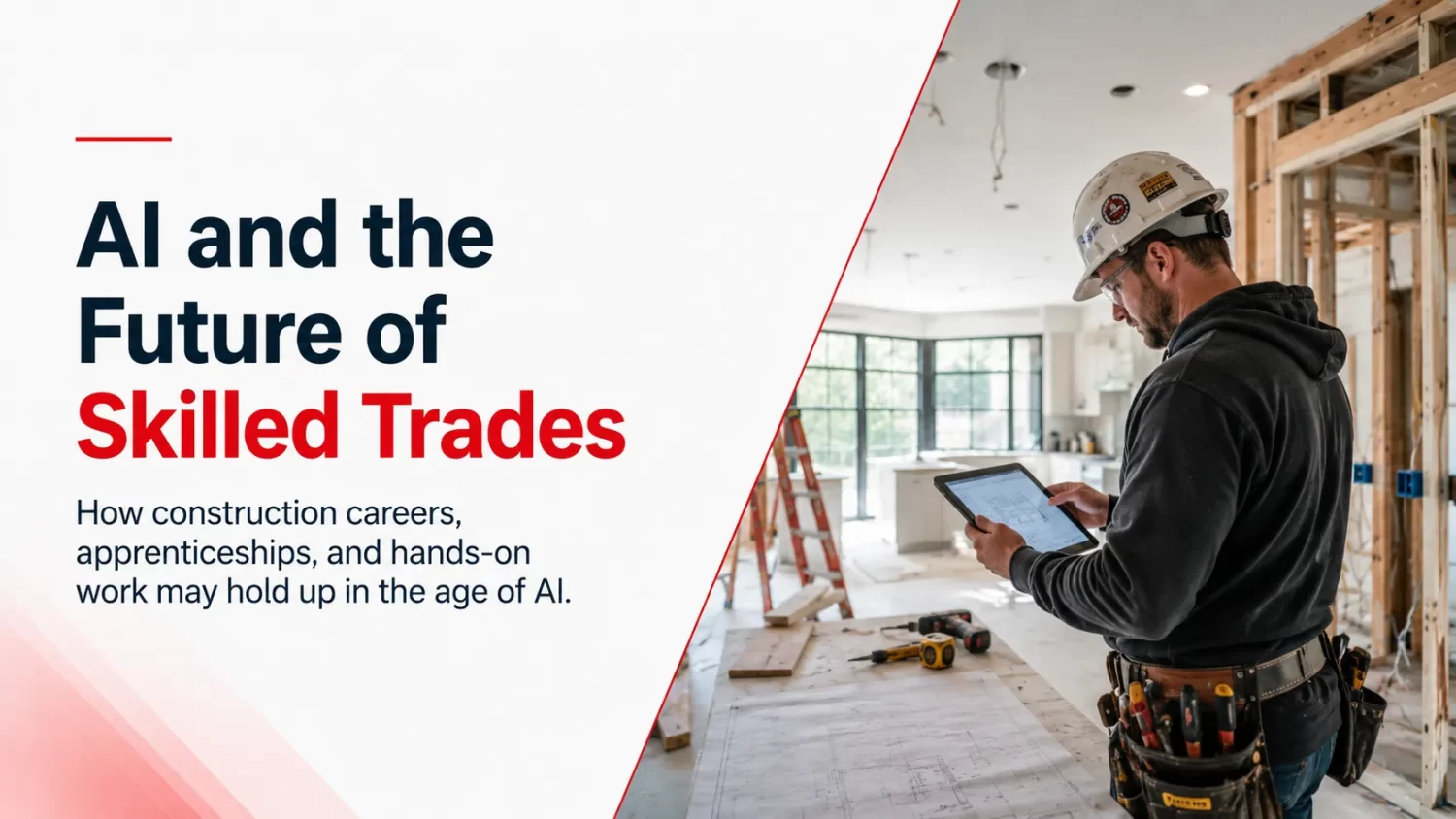
Before choosing a career path or deciding whether the trades are still a smart direction in a world shaped by artificial intelligence, it helps to look honestly at what AI can replace and what it still cannot do. In this episode, the team joins Acadia On Air to discuss AI, white-collar work, construction, skilled trades, trade school, apprenticeships, robotics, and why hands-on problem solving may become even more valuable as technology continues to evolve. For homeowners and future builders interested in interior renovations, the conversation also gives a practical look at why real construction work still depends on experienced people who can think, adapt, and execute on-site.
One of the strongest points in the episode is that AI may not eliminate entire professions overnight, but it can remove large portions of repetitive work inside those professions. Administrative tasks, basic coding, document review, simple drafting, research, and structured processes can already be handled faster with AI tools. The bigger risk is not that every field disappears, but that fewer people may be needed to complete the same amount of work. The conversation makes it clear that workers who are only doing repetitive tasks may be more exposed, while people with deeper judgment, creativity, and practical skill will remain much harder to replace.
Helpful Takeaways About AI and the Future of Trades
- AI will likely replace tasks before it replaces full professions. Many jobs may remain, but fewer people may be needed when one skilled person can do more with AI support.
- Repetitive work is the most vulnerable. Anything systematic, predictable, or repeated over and over is easier for AI to support or automate.
- Construction is different because every site is different. Real homes are full of uneven walls, unexpected conditions, hidden problems, and decisions that require judgment.
- Robotics is not the same as AI software. Even if AI can create plans or help with administration, physically building, repairing, installing, and adjusting on-site is a much harder problem.
- Trades require both hands and brain. A good trade professional is not just performing labour; they are solving practical problems in real time.
- Apprenticeship matters. Learning directly from experienced trades can be more valuable than classroom theory alone, especially for hands-on work.
- Communication is a serious trade skill. Many construction problems come from poor communication between trades, clients, and project managers.
Another important insight is that construction is not as repetitive as many people assume. A person outside the industry may think that tile, plumbing, framing, or electrical work is simply a matter of following the same steps on every project. In reality, every home brings different walls, layouts, measurements, materials, defects, and client expectations. A tradesperson often has to stop, assess the condition in front of them, and decide the best way to complete the work properly.
The episode also explores why trades may remain more protected from AI disruption than many office-based careers. AI can support planning, drawings, approvals, and project administration, but it cannot currently walk into an existing home, inspect imperfect site conditions, coordinate physical work, adjust materials, solve hidden construction issues, and complete the installation. That is where skilled trades still have a strong advantage.
At the same time, the conversation does not dismiss AI entirely. The team points out that AI may become very useful in construction administration, design support, permit review, site planning, and documentation. In the future, homeowners may be able to generate concepts, plans, or technical documents much faster than before. But even if the administrative side becomes more automated, someone still has to show up and build the project correctly.
The discussion also gets into trade school, apprenticeships, and how people should actually learn the work. Some trades require strong technical understanding, especially electrical, plumbing, HVAC, and other licensed work. But the episode also makes the case that practical site experience is critical. A person learns differently when they are standing in a real house, seeing the wires, pipes, framing, slopes, corners, finishes, and mistakes in front of them.
Another major point is communication. The trades are often judged only by physical skill, but many project problems begin when people do not explain themselves clearly. One trade may describe a material, finish, colour, or installation detail in one way, while another person understands something completely different. Strong communication prevents conflict, avoids rework, and helps clients understand what is actually happening on-site.
For young people thinking about the future, the message is practical: trades should not be treated as a backup option. Skilled trades can offer strong earning potential, real-world problem solving, independence, and the satisfaction of creating something visible. As AI changes more office-based work, the ability to build, repair, install, communicate, and think through physical problems may become even more valuable.
This blog only scratches the surface of the full conversation. Watch the full podcast above to hear the full discussion on AI, construction careers, skilled trades, robotics, apprenticeships, trade school, communication, and why hands-on expertise still matters in the future of building.