
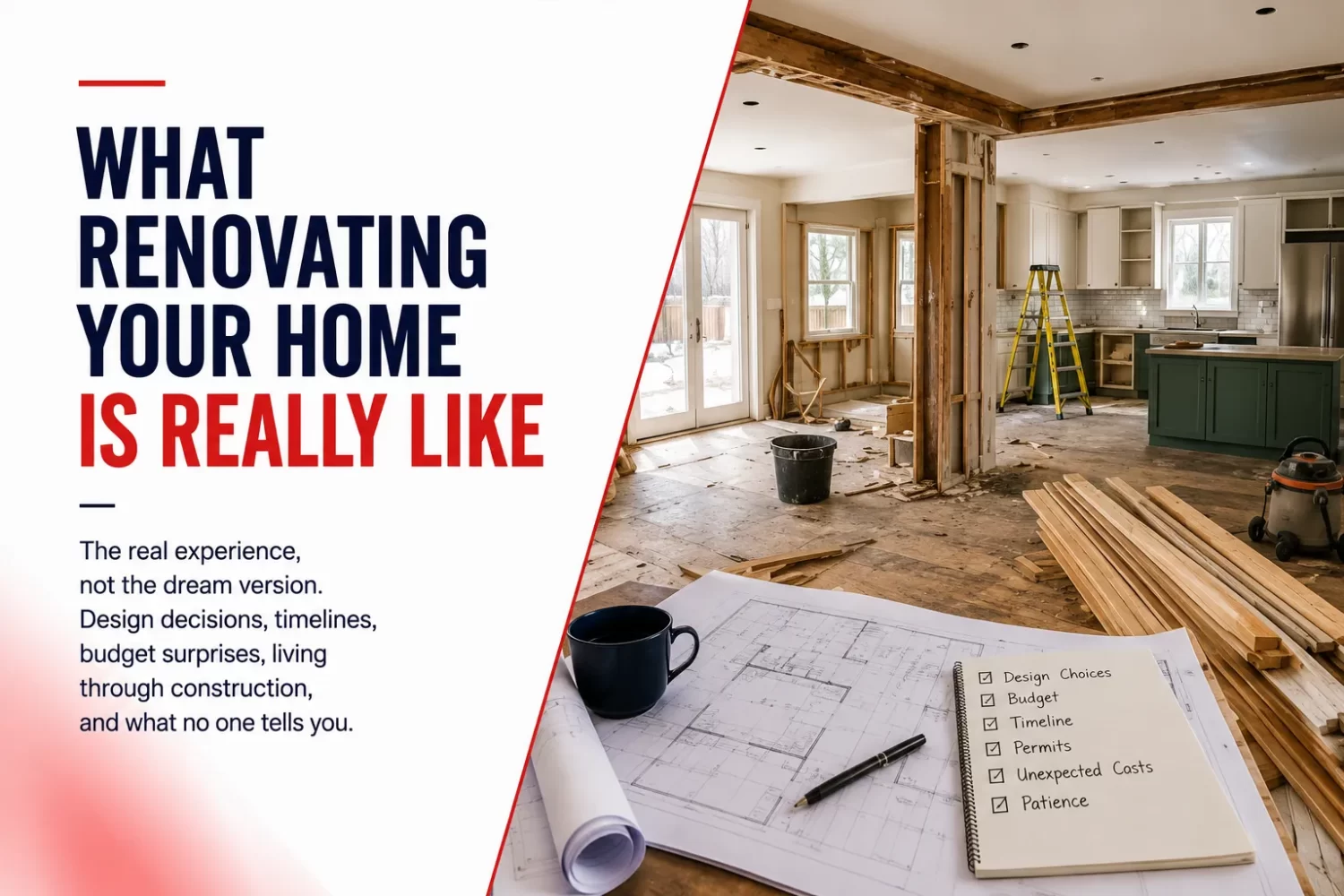
Before borrowing against your home, planning a large renovation, or buying a property with the goal of improving its value, it helps to understand the financial side of renovation more clearly. In this episode, the team joins Acadia On Air to discuss HELOCs, saved capital, refinancing, resale value, home inspections, illegal additions, renovation return on investment, finished basements, secondary units, and why proper due diligence matters before spending serious money on a house. For homeowners planning interior renovations, this conversation offers a practical reminder that renovation decisions should be planned around both lifestyle and long-term property value.
One of the strongest points in the episode is that many homeowners use a HELOC, or home equity line of credit, because full renovations often require a large amount of capital upfront. The discussion explains that as a home grows in value over time, some owners choose to borrow against that equity and reinvest into the property. A renovation can help an older or outdated home better match the value it has grown into, especially when the work improves layout, function, livability, and overall presentation.
Helpful Takeaways About Renovation Financing and ROI
- Understand your financing options. Many homeowners either save money over time or use home equity to fund major renovation work.
- Do not treat every upgrade as an investment. Some renovations improve resale value, while others are mainly personal luxuries or taste-based decisions.
- Use HELOCs carefully. Borrowing against home value can be useful, but the renovation still needs to be planned realistically and responsibly.
- Think beyond surface finishes. A move-in-ready-looking home can still hide illegal additions, poor insulation, bad drainage, structural problems, or unsafe garage separations.
- Get proper inspections and advice. A home inspector is useful, but a contractor or consultant may catch practical construction issues that a standard report misses.
- Check permits before buying. Additions, finished basements, enclosed porches, and other past work should be reviewed to confirm whether permits were pulled properly.
- Focus on upgrades with broader appeal. Finished basements, legal secondary units, first-floor renovations, and open layouts may support value more than highly personal luxury choices.
Another important insight is that renovation value is not only about making a home look nicer. A house has a baseline market value based on location, bedrooms, garage count, basement condition, lot size, and other core factors. Better finishes and a stronger renovation may convince some buyers to pay more, especially if they want a finished home and do not want to deal with construction themselves. But not every expensive upgrade automatically increases resale value by the same amount.
The episode also discusses why “move-in ready” can be misleading. A house may look clean, staged, and complete, but still have issues behind the walls, above the garage, around enclosed porches, inside insulation cavities, or under previous additions. A standard home inspection can help, but the conversation makes it clear that buyers should not assume every hidden problem will be caught. If something looks unusual, it may be worth bringing in a contractor or consultant before relying only on the inspection report.
Permits are another major part of the financial discussion. If a previous owner built an addition, finished a basement, enclosed a porch, or made structural changes without proper permits, the new owner may inherit the problem. That can turn into a serious cost later if the municipality requires the work to be legalized, opened, reviewed, reinforced, or rebuilt. The conversation makes a strong case for checking with the city before buying or investing heavily into a property.
The team also explains that inspections can become a negotiation tool. If issues are properly identified and included in a report, buyers may be able to use those findings to discuss price reductions or repairs with the seller. This is why the episode suggests that homeowners should not only “get an inspection,” but also help guide the inspection by pointing out concerns that should be reviewed and documented.
On the investment side, the episode touches on refinancing after renovations. A homeowner may buy a property, invest into improvements, have the home re-evaluated, and then refinance based on the increased value. This can be part of a broader real estate strategy, but the discussion is careful not to present it as financial advice. The practical lesson is that the numbers must make sense before the renovation starts, including purchase price, renovation cost, final value, permit risks, and market demand.
When it comes to renovations that may support value, the conversation highlights finished basements and secondary units as major examples. A finished basement adds usable square footage, while a legal secondary unit may create income potential for owners who need rental support. Load-bearing wall removals and first-floor renovations can also create value when they open the home, improve flow, and lead to a more complete modern update.
At the same time, the episode warns that luxury upgrades do not always return their cost. Pools, extremely expensive appliances, highly personal finishes, and very specific design choices may be enjoyable for the current homeowner, but they may not convince the next buyer to pay the full difference. The more personal the upgrade, the more careful homeowners should be about treating it as an investment rather than a lifestyle expense.
For homeowners, the practical lesson is simple: renovation money should be spent with a clear purpose. Some upgrades are for comfort, some are for function, some are for resale, and some are for income potential. A smart renovation plan separates those goals before the money is borrowed or spent, so the homeowner understands what they are likely to gain and what they are simply choosing because they personally want it.
This blog only scratches the surface of the full conversation. Watch the full podcast above to hear the full discussion on HELOCs, renovation financing, refinancing, home inspections, illegal additions, permits, finished basements, secondary units, resale value, and how to think more carefully before investing into a major home renovation.